Staffan
Let the Right One InStaffan’s life is divided between public authority and a household he has not yet been accepted into. He is a police officer, one of Sweden’s top five pistol shooters, a church choir member, and Yvonne’s partner. To Tommy, however, those credentials do not make him a father: they make him an increasingly present stranger, whose guns, uniform, and plans to discipline him sharpen the boy’s resistance. Staffan’s significance lies in that tension. He wants to guide and protect Tommy, yet often understands guidance as authority—and the novel repeatedly shows how little control that authority gives him.
Identity and public authority
Staffan’s pistol shooting is not casual recreation. He shows Tommy a safe under the bed where he keeps his pistols and explains that his trophies include first prize in the district championships and third prize at the national level in .45-caliber standing shooting. He is described as one of Sweden’s top five pistol shooters. The trophies make his competence tangible, while their presence in the bedroom also folds his public achievement into the intimate space Tommy is trying to understand. Tommy wonders about the relationship between Staffan and Yvonne, and about what the guns mean to them; the objects become part of his uneasy scrutiny of the couple.
His police work is presented through habits as well as rank. When Staffan arrives at a police scene, Larsson, a new recruit, is in a patrol car using the radio, and Staffan parks behind it to leave room for other vehicles. He locks his own car even when he expects to be away only briefly, explaining the habit to himself as a way of ensuring he never forgets to lock a patrol car. He then walks toward the entrance with deliberate authority, aware that the onlookers may see him as the person who will sort out the situation. The scene establishes both his professional self-command and his consciousness of how authority appears to others. Inside, several men in swimming trunks and towels approach him about their clothes, bringing the unsettled scene down from public expectation to a practical problem.
A place in Yvonne and Tommy’s home
Staffan’s relationship with Yvonne is affectionate and increasingly domestic, but its intimacy is conspicuous to Tommy. One evening Staffan plays the piano while he and Yvonne sing together; they exchange smiles, and after dinner he has shown Tommy the pistol safe. Tommy sits apart on a leather sofa, enlarging a hole in its armrest with his finger while wondering whether the couple have been intimate there, beneath the barometers, or in the bed where the pistols are stored. His attention to the sofa’s stuffing and the safe under the bed gives physical form to his discomfort: he is not simply meeting his mother’s partner but imagining the private life into which Staffan has already entered.
The strain is not erased by moments of welcome. At the church, Staffan greets Yvonne with an embrace and offers Tommy his hand; when Tommy shakes it, Staffan says he is glad they both came and especially pleased that Tommy did. He hopes Tommy will return. Yvonne strokes Tommy’s shoulder, and mentions that he has read the biblical passage Staffan is going to discuss. Staffan also raises his missing shooting trophy, suggesting that they write it off when he has not found it. The encounter combines an attempt at warmth with signs of how tentative the relationship remains: Tommy gives little response, and Staffan eventually turns back to Yvonne.
Faith, family, and discipline
Staffan’s religious life is active rather than ornamental. He sings in the choir and helps ministers prepare a service on the youth of today, drawing on the Israelites’ exodus from Egypt to develop the image of guiding stars for young people. He waits for Yvonne and Tommy outside St. Thomas Church, dressed in a suit and pale yellow-striped tie, though he has work to attend to in Åkeshov as soon as the service ends. His willingness to wait and his pleasure that Tommy has come show a genuine effort to include him in this part of his life.
That effort is complicated by Staffan’s view of his prospective parental role. When the church service is interrupted by a mishap and the building is to be cleared, Staffan quickly leaves the podium. He believes Tommy is responsible and is angry enough to imagine giving him a hiding. Yet he also recognizes that Yvonne will not accept him disciplining Tommy as matters stand. He expects that marriage will change the arrangement and thinks of taking on the task then; for the immediate moment, he wants to find Tommy and shake him up. The distinction between present restraint and future authority reveals both his frustration and the limits of his place in the family. His intended guidance is already entangled with punishment.
Yvonne later tells Tommy that Staffan did not identify him to the minister over the damage to the christening font. Staffan had found it difficult, given his faith, to lie to the minister, but had done so to protect Tommy. The episode complicates Tommy’s suspicion of him: Staffan’s religious conscience is not simply a source of moral authority but something he is willing to compromise for the boy. Tommy nevertheless remains wary, telling himself not to trust Yvonne and anticipating that Staffan might start on him about something. After Yvonne hugs him, Tommy leaves for the basement, where he throws a blanket and pillow onto the couch, takes chewing tobacco, and thinks that it would be best if he were shot. Staffan’s protection has not secured Tommy’s trust or relieved his distress.
Authority under pressure
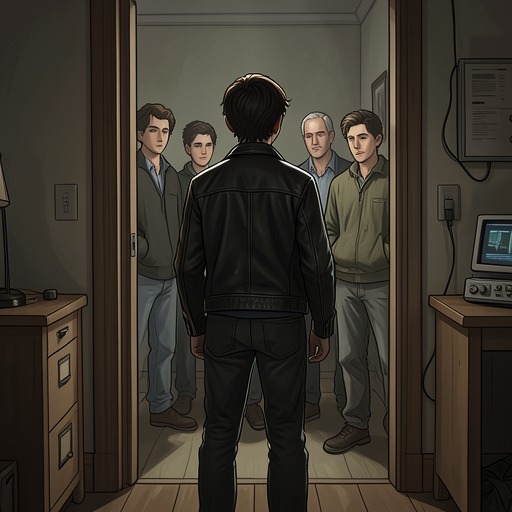
Staffan’s uniform later becomes a deliberate instrument in his approach to Tommy. On a Monday when Tommy starts school at quarter to nine, Staffan gets up at eight, drinks coffee, and prepares to go downstairs for a man-to-man talk. Yvonne has already left for work. Staffan is due at Judarn Forest at nine to continue a search he expects to be fruitless, but he first considers speaking to Tommy in ordinary clothes, as one person to another. He chooses his uniform instead, reasoning that the matter is technically a police matter—vandalism—and that the uniform gives him a shell of authority. His choice makes explicit what earlier scenes imply: when personal connection feels uncertain, he reaches for the force of his office.
The search and the conversation he intends to have are overtaken by what he finds. Staffan opens a door with his baton and sees Tommy kneeling behind a mass of remains so mutilated that the body is difficult to recognize, an arm partly separated from it. Tommy is holding a square stone in both hands and repeatedly thrusting it down into the flesh in time with a song; each blow passes through with little resistance and strikes the floor. The scene confronts Staffan, the would-be disciplinarian and police officer, with a violence that cannot be handled as an ordinary breach of rules. His planned talk and the authority of the uniform give way to the sight of Tommy in the midst of the destruction. Staffan’s arc remains unresolved in these moments: he has tried to make a family place for himself through welcome, faith, protection, and discipline, but the image he encounters exposes how far that intention is from command or understanding.